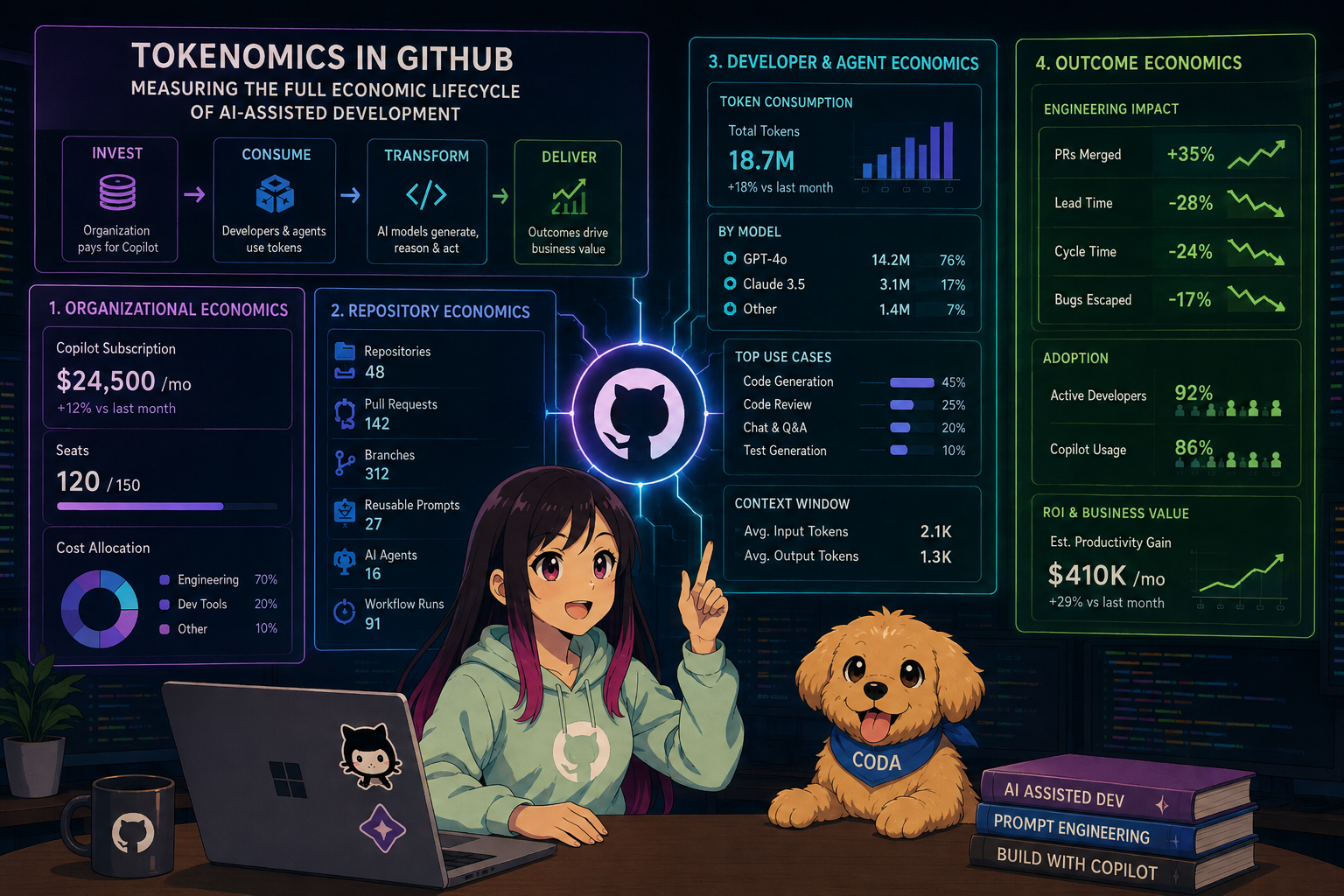
Tokenomics for AI Coding Agents: A Systems View of GitHub Copilot Usage Based Billing
A deep technical guide to token flow, orchestration overhead, cost governance, and practical optimization patterns in AI coding workflows.
Why tokenomics now matters for software teams
GitHub Copilot usage is increasingly measurable and governable, which means token economics has become a systems engineering concern. Teams now need to reason about model context, orchestration patterns, retries, and output design with the same rigor they apply to performance and reliability.
The core challenge is balance. You need high quality responses without uncontrolled token growth. That requires architecture choices, not just policy documents.
A practical token model
Total token consumption can be modeled as:
Total Tokens = Σ (Input Tokens + Output Tokens + Orchestration Overhead)In multi step agentic workflows, orchestration overhead can become a major component. Each turn may carry repeated scaffolding, context framing, and tool interface metadata. If that repetition is unmanaged, cost grows quickly without proportional quality gains.
Token lifecycle in coding workflows
- Ingestion: prompt plus repository context
- Planning: task decomposition and routing
- Execution: code search, edits, and synthesis
- Verification: tests, logs, and diagnosis
- Delivery: PR summaries, explanations, and docs
Each stage has different failure modes. Ingestion can over attach context, planning can over fragment into tiny turns, execution can repeatedly re read unchanged files, and verification can dump full logs when only narrow excerpts are needed.
Engineering patterns for efficiency
Progressive context loading
Start with small, high relevance context and expand only when uncertainty increases. This controls average input size and improves response time.
Deterministic chunking
Split large files into stable chunks and reference chunk identifiers instead of repeatedly attaching full files. This improves reproducibility and trims repeated token payload.
Stateful summaries
Maintain concise rolling summaries of what is known, what changed, and what remains unresolved. This reduces transcript replay costs across turns.
Retry budgets
Retries should be policy driven. Limit attempts, classify transient versus terminal failures, and route failing tasks to fallback strategies.
JavaScript example: centralized token instrumentation
This snippet demonstrates a clean wrapper around model calls. It logs token usage, enforces per workflow limits, and emits structured telemetry.
/**
 * Central token budget manager.
 * Keeps accounting logic in one place so all workflows follow the same rules.
 */
class TokenBudgetManager {
  constructor(maxTokensPerWorkflow = 200000) {
    this.maxTokensPerWorkflow = maxTokensPerWorkflow;
    this.workflows = new Map();
  }

  getOrCreate(workflowId) {
    if (!this.workflows.has(workflowId)) {
      this.workflows.set(workflowId, {
        inputTokens: 0,
        outputTokens: 0,
        requests: 0
      });
    }
    return this.workflows.get(workflowId);
  }

  register(workflowId, inputTokens, outputTokens) {
    const stats = this.getOrCreate(workflowId);
    stats.inputTokens += inputTokens;
    stats.outputTokens += outputTokens;
    stats.requests += 1;

    const total = stats.inputTokens + stats.outputTokens;
    if (total > this.maxTokensPerWorkflow) {
      throw new Error(`Token budget exceeded: ${total}/${this.maxTokensPerWorkflow}`);
    }
    return { ...stats, totalTokens: total };
  }
}

/**
 * Wrapper that executes one model call and emits telemetry.
 */
async function runWithTokenMetrics({ workflowId, stage, model, callModel, budgetManager, emit }) {
  const start = Date.now();

  const result = await callModel();

  const inputTokens = Number(result?.usage?.input_tokens || 0);
  const outputTokens = Number(result?.usage?.output_tokens || 0);

  const budget = budgetManager.register(workflowId, inputTokens, outputTokens);

  emit({
    event: "llm_usage",
    workflowId,
    stage,
    model,
    inputTokens,
    outputTokens,
    totalWorkflowTokens: budget.totalTokens,
    latencyMs: Date.now() - start,
    timestamp: new Date().toISOString()
  });

  return result;
}
Python example: adaptive context compaction
This example shows deterministic context selection under a hard token target. The logic is intentionally simple for operational clarity.
from dataclasses import dataclass
from typing import List

@dataclass
class ContextBlock:
    # Unique identifier for observability and reproducibility
    block_id: str
    # Larger value means higher relevance
    priority: int
    # Raw text passed to the model
    text: str

def estimate_tokens(text: str) -> int:
    # Lightweight estimate for planning.
    # Replace with model tokenizer for precise accounting in production.
    if not text:
        return 0
    return max(1, len(text) // 4)

def compact_context(blocks: List[ContextBlock], max_tokens: int) -> List[ContextBlock]:
    # Deterministic sort improves repeatability between runs.
    ordered = sorted(blocks, key=lambda b: b.priority, reverse=True)

    selected: List[ContextBlock] = []
    used = 0

    for block in ordered:
        t = estimate_tokens(block.text)
        if used + t > max_tokens:
            continue
        selected.append(block)
        used += t

    return selected
Governance model for platform teams
- Set team and workflow token budgets
- Track tokens per successful task and per merged PR
- Alert on retry spikes and abnormal token ratios
- Standardize telemetry fields across tools
- Review optimization opportunities monthly
A useful insight from real deployments is that one workflow stage often dominates spend. Stage level tagging helps you prioritize quickly and avoid broad, disruptive process changes.
Conclusion
Usage based billing should be viewed as an engineering catalyst. Teams that design for token efficiency with observability, deterministic context handling, and policy driven orchestration can improve both cost predictability and developer throughput.