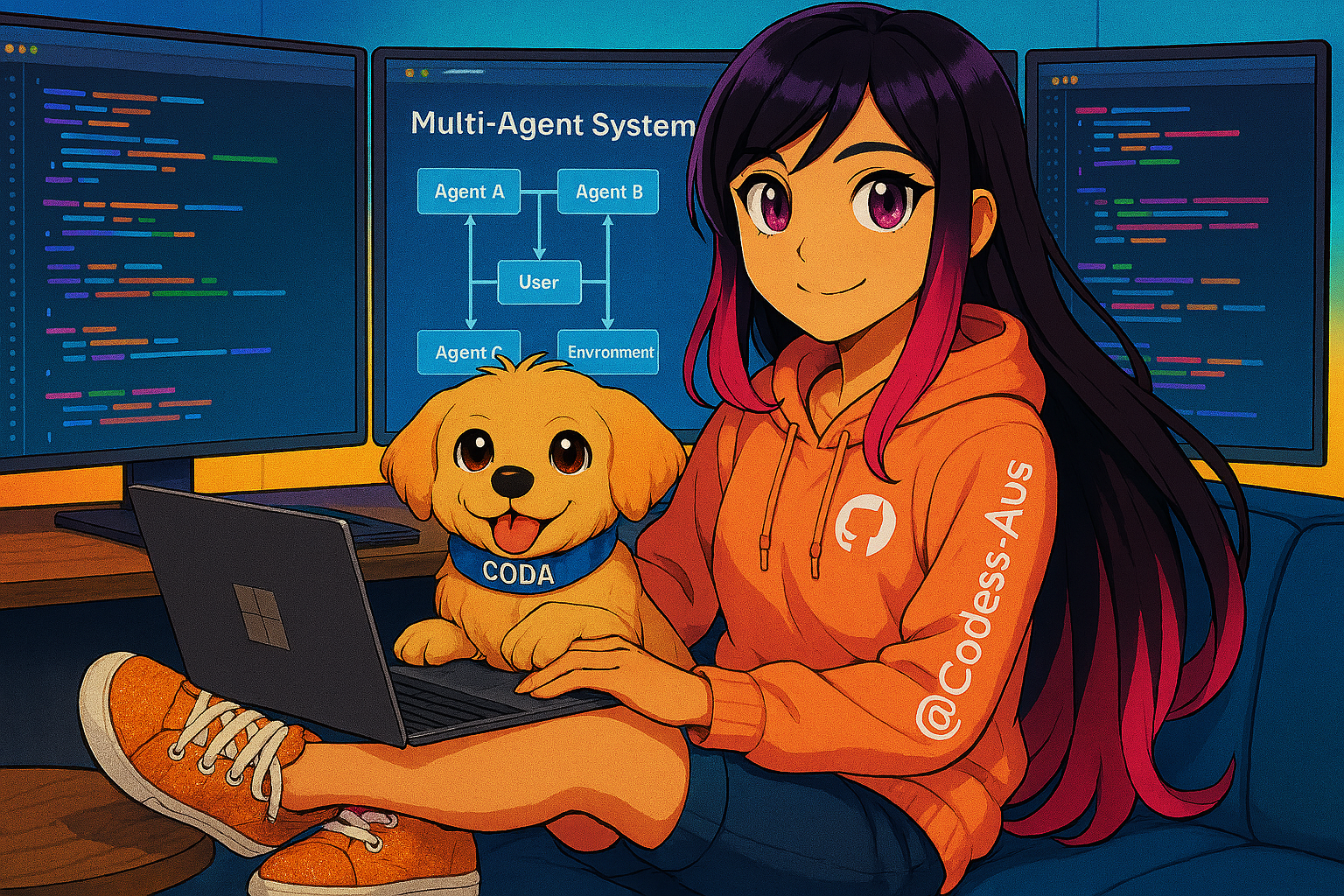
🚀🌟 Building Advanced Agentic AI Systems (Multi-Agent Architectures) with GitHub Copilot 🌟🤖
The increased demand for adaptive, distributed AI solutions has made agentic (multi-agent) architectures a powerful paradigm for scalable automation and intelligent software. Today, I'll break down proven steps for designing a robust multi-agent AI system—and show how GitHub Copilot accelerates every stage, from ideation to deployment.
What is "Agentic AI"?
An agentic system is one where multiple AI-powered agents have distinct responsibilities and can collaborate, coordinate, or negotiate to solve tasks—think of a group of specialized automated processes, each optimizing a particular function in a broader workflow.
Building Your Multi-Agent Foundation:
1. Define Individual Agents
Each agent should serve a specific purpose—such as "Natural Language Processing," "Data Enrichment," or "Decision Logic." Clear separation of concerns is crucial for modularity, maintainability, and scaling.
# Python: Prototype an agent class
class DataAgent:
    def fetch(self, query):
        # Fetch data from APIs or DB
        pass

class NLPAgent:
    def interpret(self, text):
        # Natural Language Understanding logic
        pass
2. Choose a Communication Method
Agents must exchange information efficiently. Typical solutions include message queues (like RabbitMQ, Kafka), event buses, or async function calls. Python's asyncio or Node.js's EventEmitter are practical for intra-service communication.
# Using asyncio for lightweight agent communication
import asyncio

async def agent_a():
    await asyncio.sleep(1)
    print("Agent A: Ready!")

async def agent_b():
    await asyncio.sleep(2)
    print("Agent B: Ready!")

asyncio.run(asyncio.gather(agent_a(), agent_b()))
3. Orchestrate and Coordinate
Employ an orchestrator or controller agent to direct workflows and manage inter-agent dependencies and results aggregation.
// In JavaScript/Node.js: Orchestrator example
class Orchestrator {
    constructor(agents) {
        this.agents = agents;
    }
    async runMission(input) {
        const nlpResult = await this.agents.nlp.interpret(input);
        const data = await this.agents.data.fetch(nlpResult.query);
        return data;
    }
}
4. Iterate & Collaborate on GitHub
Leverage Copilot for rapid prototyping, AI-powered code reviews, automated test generation, and inline technical documentation. This accelerates iteration, ensures quality, and promotes best practices.
5. Monitor & Scale
Integrate CI/CD pipelines (e.g., GitHub Actions), set up telemetry (Prometheus, Grafana), and automate deployment to meet production-grade requirements for your AI agent ecosystem.
# GitHub Actions: Example to run agent tests automatically
jobs:
  test-agents:
    runs-on: ubuntu-latest
    steps:
      - uses: actions/checkout@v3
      - name: Set up Python
        uses: actions/setup-python@v4
      - name: Run tests
        run: python -m unittest discover tests/
Why use GitHub Copilot for Multi-Agent Systems?
- Rapid Prototyping: Skip repetitive code - Copilot predicts scaffolding routines and APIs, letting you focus on high-value architecture.
- Improved Code Quality: Catch errors early and iterate confidently.
- Collaborative Development: Accelerate onboarding and documentation; explore alternative patterns for agent composition.
Summary
By combining a modular agent design, robust communication protocols, intelligent orchestration, and disciplined engineering practices, you can achieve scalable, maintainable, and efficient AI systems. With GitHub Copilot, technical teams unlock new productivity levels along the entire development pipeline.